
TL;DR: Specialist-hopping — bouncing between an orthopedist, a physical therapist, a pain doctor, and a PCP — leads to fragmented care, repeated tests, conflicting advice, and wasted money. Integrated care puts your entire treatment team under one roof with one coordinated plan. At Innovare Tx in Dallas, our multidisciplinary model combines diagnosis, orthobiologic medicine, physical therapy, and medical management into a single, seamless experience. The result: faster recovery, lower costs, and nothing falling through the cracks.
If you’ve ever spent months bouncing between doctors — one for the diagnosis, another for imaging, a third for physical therapy, a fourth for injections — you already know the frustration. Each office has its own intake forms. Its own wait times. Its own plan that doesn’t quite match what the last doctor said.
You’re not getting integrated care vs. specialists working together. You’re getting fragments. And fragments don’t heal people.
As a provider with 27 years of medical experience, I’ve watched this broken cycle exhaust patients physically, emotionally, and financially. That’s exactly why we built Innovare Tx around a different model — a one-stop medical clinic where your treatment team actually talks to each other, because they work side by side.
Let me explain why that matters and how it works.
The Problem: What Specialist-Hopping Actually Costs You
The traditional healthcare model assumes you’ll see a different provider for every problem. Knee pain? Start with your PCP for a referral. Wait two weeks. See the orthopedist. Get imaging. Wait for results. Get referred to physical therapy — at a completely different office. If PT doesn’t work, you’re sent elsewhere. More intake forms. More copays. More waiting.
Here’s what that fragmented approach really costs:
- Time: The average specialist referral loop takes 4–8 weeks from PCP visit to treatment start. Multiply that across two or three specialists.
- Money: Each office visit means a new copay or deductible. Repeated imaging because the new office “needs their own.” Out-of-network surprises.
- Conflicting advice: Your orthopedist says rest. Your PT says move. Another provider prescribes medication that masks the underlying issue. Nobody is coordinating.
- Lost information: Medical records don’t transfer seamlessly. Critical notes get buried. You end up being your own care coordinator — and that’s not your job.
- Delayed recovery: Every gap between appointments is a gap in healing. Momentum is lost. Conditions worsen.
This isn’t a rare experience. Studies show that patients with musculoskeletal conditions see an average of 3.5 providers before receiving definitive treatment. That’s 3.5 sets of intake paperwork, 3.5 explanations of your medical history, and 3.5 chances for miscommunication.
You deserve better. Coordinated healthcare exists — and it works.
What Integrated Care Actually Means
Integrated care isn’t just a buzzword. It’s a fundamentally different approach to treating patients.
In an integrated model, your providers share a treatment plan, communicate in real time, and adjust your care together — not in isolation. There’s no “telephone game” between offices. No month-long referral delays. No conflicting instructions.
The Three Pillars of True Integrated Care
- One team. Your providers know each other, work together daily, and share clinical decision-making.
- One plan. Your treatment protocol is designed holistically — not pieced together from disconnected appointments.
- One location. Everything happens under one roof. Fewer drives. Fewer copays. Fewer chances for things to fall through the cracks.
This is what a comprehensive care clinic Dallas patients can actually rely on looks like. Not a network of loosely affiliated providers — a genuine team.
How Innovare Tx Does It: Our Integrated Care Model
At Innovare Tx, we designed our clinic specifically to avoid specialist-hopping by combining the disciplines patients need most under one roof.
Meet the Team
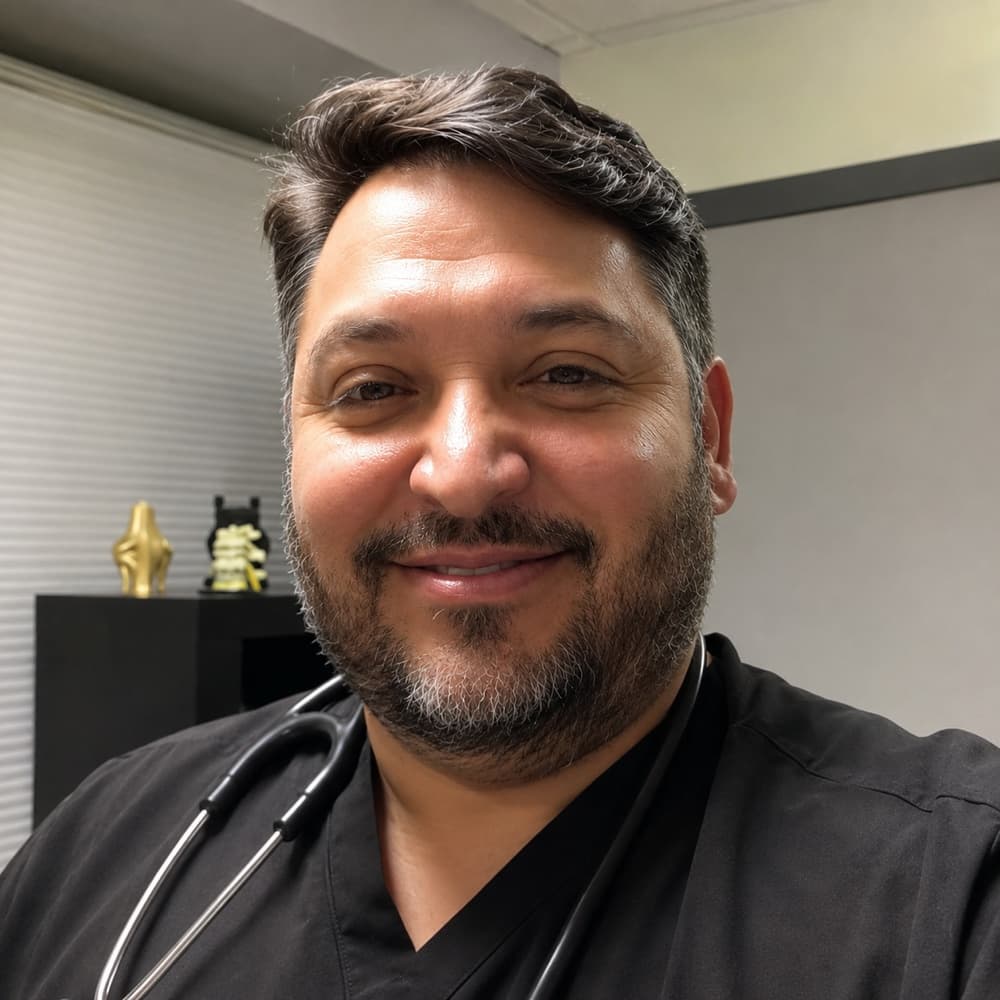
Charles Ortega, PA-C, MPAS — With 27 years of medical experience, Charles handles your initial evaluation, diagnosis, and medical management. He specializes in orthobiologic medicine (PRP, BMAC, A2M), neuropathy treatment, weight management, and federal workers’ compensation (OWCP) cases. He’s also your primary care provider if you need one.
Rowena Calleja, PT — Our physical therapist specializes in musculoskeletal rehabilitation, post-procedural recovery (after autologous orthobiologic procedures), sports injuries, chronic pain, and workers’ comp PT. She works directly alongside Charles — not in a separate office across town.
What This Looks Like in Practice
When you come to Innovare Tx, here’s what happens:
- Single evaluation. Charles sees you, reviews your history, performs your exam, and orders any necessary imaging — all in one visit.
- Coordinated treatment plan. If an autologous orthobiologic procedure and physical therapy are appropriate for you, Charles and Rowena design the plan together. Your PRP injection timeline is synchronized with your PT protocol.
- Real-time adjustments. If Rowena notices something during your PT session — a new limitation, faster-than-expected progress — she walks down the hall and talks to Charles. Your plan updates that day, not six weeks later at your next specialist appointment.
- Ongoing medical management. Weight management, chronic disease management, medication adjustments — it all happens here. No outside referral needed.
This is multidisciplinary healthcare the way it should work.
Real-World Scenarios: Integrated Care in Action
Theory is great. Let’s talk about how this plays out for real patients.
Scenario 1: The Knee Pain Patient
The old way: Maria, 55, has chronic knee pain from osteoarthritis. Her PCP refers her to an orthopedist (3-week wait). The orthopedist orders an MRI (1-week wait for the appointment, another week for results). He recommends cortisone injections and physical therapy. Maria schedules PT at a separate clinic (2-week wait for an opening). After 8 weeks of PT, she’s marginally better. The orthopedist suggests surgery. Total time: 4+ months. Total out-of-pocket: $1,500–3,000+ across multiple offices and copays.
The Innovare Tx way: Maria sees Charles. He evaluates her knee, reviews imaging, and — after a clinical evaluation to determine whether she is an appropriate candidate — discusses an autologous orthobiologic procedure (PRP) as one option to consider alongside physical therapy. That same week, Rowena begins a PT protocol coordinated with Charles’s plan, and the two check in on her progress together. One clinic. One team. One plan.
Scenario 2: The Weight Management Patient
The old way: James, 42, wants to lose weight and manage his pre-diabetes. His PCP prescribes metformin and says “eat less, move more.” He signs up for a telehealth GLP-1 program — gets compounded semaglutide mailed to his door with no in-person monitoring. He loses some weight but feels fatigued and has no idea if his labs are improving. No one coordinates his metabolic care with his musculoskeletal issues (his back pain has worsened from carrying extra weight for years).
The Innovare Tx way: James enrolls in our weight management program with compounded tirzepatide at $160/month. Charles monitors his labs, adjusts his medication in person, and identifies that his back pain is related to deconditioning. Rowena starts a targeted PT program to strengthen his core while he’s losing weight. His metabolic health and musculoskeletal health improve together. That’s the power of a one-stop medical clinic.
Scenario 3: The Federal Workers’ Comp Patient
The old way: David, a USPS mail carrier, injures his shoulder on the job. He files a CA-1, but his assigned doctor doesn’t understand OWCP paperwork. His claim stalls. He’s referred to an outside PT who doesn’t communicate with his treating physician. Documentation gaps delay his authorization. He’s in pain, frustrated, and worried about his job.
The Innovare Tx way: David exercises his right to choose his own doctor and comes to Innovare Tx. Charles — who has extensive experience with federal employees from USPS, TSA, DHS, CBP, and DOD — handles his CA-1 documentation correctly from day one. He orders imaging, provides a diagnosis, and — where appropriate after a clinical evaluation — discusses an autologous orthobiologic procedure. Rowena starts workers’ comp PT in the same building. Every treatment note, every progress report, every OWCP form is coordinated. David’s claim moves forward. One team handled everything.
The Benefits of Integrated Care: By the Numbers
Why does coordinated healthcare produce better outcomes? It’s not magic — it’s communication.
Compared with fragmented care, integrated care at Innovare Tx cuts time to treatment from 4–8 weeks of referral loops down to days or a single week. You visit one office instead of 3–5. The team manages care coordination instead of leaving it to you. Conflicting treatment plans are eliminated rather than common, and duplicate imaging or tests never happen instead of being frequent. Copays are consolidated rather than multiplied across providers, and communication between providers is real-time and in-person rather than faxed notes (maybe).
Faster recovery. Lower costs. Better communication. Nothing falls through the cracks. These aren’t just theoretical advantages. This is what patients at our comprehensive care clinic in Dallas experience every week.
When You DO Need a Specialist: Our Honest Take
We believe in integrated care — but we also believe in transparency. There are times when a specialist referral is the right call.
If you need surgery, we’ll refer you to an orthopedic surgeon we trust. If you need advanced cardiac workup, we’ll connect you with a cardiologist. If your condition requires subspecialty care that’s outside our scope, we’ll tell you — clearly and promptly.
The difference? Even when we refer out, we stay involved. We coordinate with your specialist. We manage your pre-surgical and post-surgical care. We make sure you don’t get lost in the system.
That’s what a real multidisciplinary healthcare team does. We don’t pretend to do everything — we make sure everything gets done right.
The Future of Healthcare Is Integrated
The specialist-heavy model made sense when medicine was simpler. Today, chronic conditions, overlapping diagnoses, and complex treatment options demand coordination — not fragmentation.
The healthcare industry is moving toward integrated models. Value-based care. Team-based treatment. Patient-centered medical homes. At Innovare Tx, we’re not waiting for the system to catch up. We’re already here.
If you’re tired of being your own care coordinator — driving across the DFW metroplex, repeating your medical history to five different offices, and hoping someone connects the dots — there’s a better way.
One clinic. One team. One plan. That’s Innovare Tx.
Ready to Experience Integrated Care?
Stop bouncing between providers and start healing with a coordinated plan.
Call us at (214) 233-3094, email contact@innovaretx.com, or visit us at 16901 Dallas Parkway, Suite 210, Addison, TX 75001. We accept BCBS, Medicare, UHC, and Cigna, plus Affirm and CareCredit financing. Military and law enforcement discounts available. Schedule your appointment today.
What is integrated care, and how is it different from seeing specialists?
Integrated care means your providers work as a single coordinated team — sharing one treatment plan, communicating in real time, and treating you under one roof. Unlike specialist-hopping, where each doctor works independently with limited information, integrated care eliminates conflicting advice, duplicate tests, and referral delays. The result is faster treatment, better outcomes, and significantly lower out-of-pocket costs for patients.
Can one clinic really handle everything I need?
At Innovare Tx, we cover the services most patients need: primary care, autologous orthobiologic procedures (PRP, BMAC), physical therapy, weight management, neuropathy treatment, and workers’ compensation care. If you need specialized surgery or subspecialty care outside our scope, we refer you to trusted specialists — and we stay involved in coordinating your care. You’re never left to navigate the system alone.
How does Innovare Tx coordinate care between providers?
Charles Ortega, PA-C, and Rowena Calleja, PT, work side by side in the same clinic. They design treatment plans together, share notes in real time, and adjust protocols on the fly. If your physical therapist notices a change during your session, your medical provider knows about it the same day — not weeks later through a faxed report. That’s real coordination.
Is integrated care more expensive than seeing individual specialists?
Integrated care is typically less expensive because you avoid duplicate imaging, redundant office visits, and multiple copays across different offices. At Innovare Tx, we also offer transparent pricing — for example, compounded tirzepatide for weight management at $160/month — and accept major insurance plans including BCBS, Medicare, UHC, and Cigna. Financing through Affirm and CareCredit is also available.
Do you accept insurance and workers’ compensation cases?
Yes. Innovare Tx accepts BCBS, Medicare, UHC, and Cigna. We also specialize in OWCP (federal workers’ compensation) for federal employees including USPS, TSA, DHS, CBP, DOD, and VA workers. If you’ve been injured on the job, you have the right to choose your own doctor — and our team handles all OWCP documentation and coordination from day one.
How do I get started with integrated care at Innovare Tx?
Getting started is simple. Call us at (214) 233-3094, email contact@innovaretx.com, or book online through our Tebra scheduling portal. Your first visit includes a comprehensive evaluation with Charles Ortega, PA-C, who will develop a coordinated treatment plan tailored to your needs. No referral required for most services.
PRP, PPP, BMAC, and A2M are autologous procedures prepared from your own blood or bone marrow. They are considered investigational and are not FDA-approved for the treatment of any specific orthopedic condition, including osteoarthritis. Individual results are not guaranteed. Any decision to pursue an orthobiologic procedure should be made with your provider after a clinical evaluation.