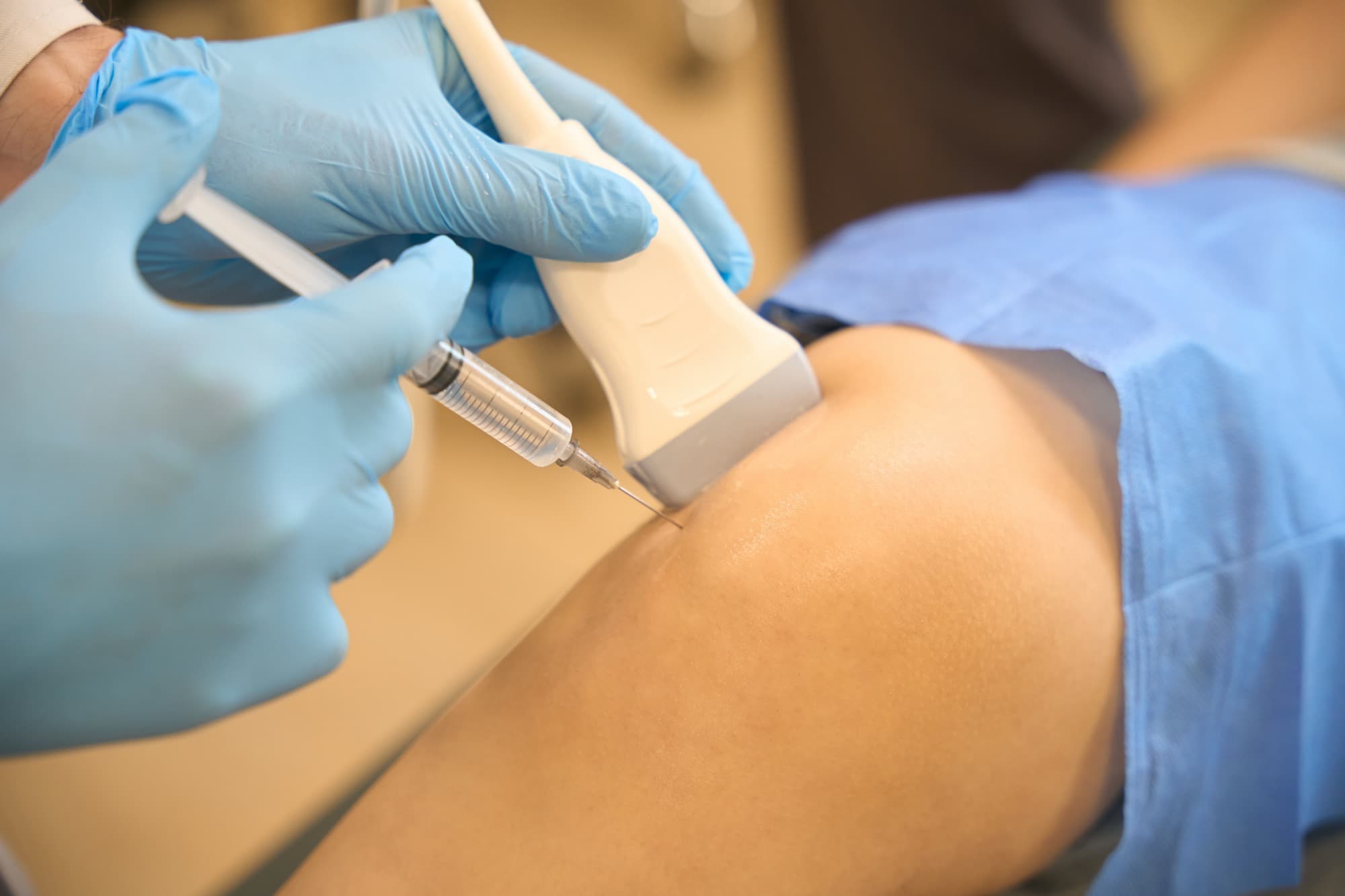


TL;DR: PRP (platelet-rich plasma) concentrates the platelets and growth factors from your own blood, while BMAC (bone marrow aspirate concentrate) is prepared from your own bone marrow and also contains a population of cells. Both are autologous, same-day orthobiologic procedures, and whether either is an appropriate option depends on your imaging, history, and a clinical evaluation. At Innovare Tx in Addison, TX, we help you understand the two procedures through our orthobiologic medicine consultation.
Once patients learn about autologous orthobiologic procedures, a common next question is: what is the difference between PRP and BMAC? They sound similar and both come from your own body — but they are prepared differently, and a clinical evaluation helps determine which, if either, is an appropriate option for you.
Here’s a clear, side-by-side breakdown so you can walk into your consultation knowing the right questions to ask.
The Short Version
Both PRP and BMAC are autologous — made from your own tissue, processed, and reinjected the same day. The core difference is what each delivers:
- PRP delivers a concentrated dose of growth factors from your blood’s platelets.
- BMAC contains those growth factors plus a population of cells (including mesenchymal cells) drawn from your bone marrow.
In simple terms: PRP concentrates the signaling proteins from your blood; BMAC is drawn from bone marrow and also includes a cellular fraction. Both are prepared from your own tissue.
BMAC vs PRP: Side-by-Side Comparison
| Feature | PRP (Platelet-Rich Plasma) | BMAC (Bone Marrow Aspirate Concentrate) |
|---|---|---|
| Source | A small blood draw | Bone marrow aspiration (usually from the hip) |
| What it contains | Concentrated platelets & growth factors | Growth factors plus a cellular fraction |
| Typically discussed for | Tendon, ligament, and milder joint concerns | More advanced joint concerns, or when a more cellular preparation is considered |
| Collection comfort | Like a routine blood draw | Bone marrow draw under local anesthesia; more involved |
| Procedure time | About 30–45 minutes | About 45–60 minutes |
| Recovery | Mild soreness 2–3 days | Mild soreness at both the harvest and injection sites |
| Typical cost | Lower | Higher (more processing and a more involved procedure) |
When PRP Is Often Discussed First
PRP is often the starting point of the conversation when:
- The concern involves a tendon or ligament — tennis elbow, Achilles, rotator cuff tendon.
- Joint changes are milder and a simpler preparation is being considered.
- You want the simplest, lowest-cost orthobiologic option first.
- You’re an active adult with a sports or overuse concern.
For a deeper look at the biology behind it, see our guide on how PRP injections work.
When BMAC May Come Up
BMAC tends to be discussed when:
- Joint changes are more advanced on imaging.
- A prior PRP procedure has been performed and a more cellular preparation is being weighed.
- Your provider and you are considering a bone-marrow-derived rather than blood-derived preparation.
BMAC is part of our broader autologous orthobiologic program. Importantly, this uses your own adult cells — there are no embryonic cells, no donor tissue, and, because the material is your own, minimal risk of rejection.
Can They Be Combined?
Sometimes. Plans are individualized, and in certain cases a provider may combine or sequence procedures. The only way to understand which path may be appropriate for you is a thorough clinical evaluation that includes your imaging and history.
How We Help You Decide
At Innovare Tx, we don’t default everyone to the most expensive option. We review your X-rays or MRI, examine the joint, and weigh your history, your activity goals, and your budget before discussing PRP, BMAC, or a combination. Formal rehab is not usually needed after either procedure; when it is indicated, our physical therapist works alongside your provider.
Is BMAC better than PRP?
Neither is universally “better” — they are different preparations from different sources. BMAC is drawn from bone marrow and includes a cellular fraction, while PRP is a lower-cost, blood-derived preparation. Whether either is an appropriate option for you is a decision to make with your provider after a clinical evaluation with imaging review.
Is bone marrow aspiration painful?
The bone marrow draw is performed under local anesthesia. Most patients describe pressure rather than sharp pain during the harvest, with mild soreness at the site for a few days afterward. It is more involved than a simple blood draw, which is one reason BMAC is reserved for cases that genuinely call for it.
Are PRP and BMAC made from my own body?
Yes. Both are autologous — PRP from your blood, BMAC from your bone marrow — collected, concentrated, and reinjected the same day. There is no donor material and no rejection risk. To talk through whether either is an appropriate option for you, contact Innovare Tx at (214) 233-3094 or learn more about our orthobiologic procedures.
PRP, PPP, BMAC, and A2M are autologous procedures prepared from your own blood or bone marrow. They are considered investigational and are not FDA-approved for the treatment of any specific orthopedic condition, including osteoarthritis. Individual results are not guaranteed. Any decision to pursue an orthobiologic procedure should be made with your provider after a clinical evaluation.