
Hip pain care in Addison & Dallas, TX
Hip arthritis, bursitis, or a labral issue can make every step and every stair a chore. At Innovare Tx in Addison, we evaluate the source of hip pain and offer conservative options — integrated physical therapy and autologous orthobiologic procedures — coordinating a surgical referral when the imaging calls for it.
Why hip pain deserves a careful look
The hip is a deep ball-and-socket joint that carries your body weight with every step, so even modest wear or inflammation can cause outsized pain. Hip problems are also famous for hiding — pain can show up in the groin, the outer hip, the buttock, or even refer down the thigh, and back conditions can mimic it. Pinpointing the likely source is the first and most important step.
Common causes of hip pain
- Osteoarthritis — cartilage wear in the joint that causes groin pain, stiffness, and reduced range of motion.
- Trochanteric bursitis — inflammation on the outer hip, often painful when lying on that side.
- Labral tears — damage to the cartilage ring around the socket, causing catching, clicking, or deep pain.
- Gluteal tendinopathy — irritation of the tendons on the outer hip.
- Hip impingement (FAI) — abnormal contact in the joint that pinches with certain movements.
Symptoms worth evaluating
- Groin or outer-hip pain with walking or stairs
- Stiffness getting out of a chair or car
- Pain when lying on the affected side
- Catching, clicking, or a deep ache in the joint
- Reduced range of motion or a shortened stride
- Pain that returns each time an injection wears off
Your options at Innovare Tx
We start conservative and build the plan around what your imaging shows. Options include physical therapy and rehabilitation as well as autologous orthobiologic procedures, described below.
PRP injections
Platelet-rich plasma (PRP) is a concentration of platelets prepared from a small sample of your own blood and placed at the joint or tendon under image guidance in the same visit. It is an autologous, minimally manipulated procedure we offer at Innovare Tx. Explore PRP injections
BMAC — bone marrow aspirate concentrate
BMAC is prepared from your own bone marrow. A small aspirate is drawn under local anesthetic, concentrated, and delivered by image-guided injection — an autologous, same-day procedure with no donor tissue. Learn about BMAC
Integrated physical therapy
The muscles around the hip — glutes, core, and hip stabilizers — are central to recovery. Rowena Calleja, PT builds a hip-specific program to restore motion, rebuild strength, and work on movement patterns, as part of your coordinated care. See our physical therapy program
Primary care that connects the dots
With family practice under the same roof, contributors to hip pain — weight, inflammation, and overall metabolic health — can be addressed as part of the same coordinated plan.
PRP, PPP, BMAC, and A2M are autologous procedures prepared from your own blood or bone marrow. They are considered investigational and are not FDA-approved for the treatment of any specific orthopedic condition, including osteoarthritis. Individual results are not guaranteed. Any decision to pursue an orthobiologic procedure should be made with your provider after a clinical evaluation.
How candidacy is determined
- A clinical evaluation reviews your imaging and history
- Mild-to-moderate hip osteoarthritis on imaging is discussed
- Bursitis, gluteal tendinopathy, or certain labral issues are considered
- Anyone whose injections keep wearing off
- Active people willing to follow a rehab plan
Severe, advanced bone-on-bone arthritis or major structural damage may still require hip replacement — and we'll tell you honestly and refer you when surgery is the right answer.
What to expect at your visit
Your first visit is an evaluation: history, exam, and review of your imaging. If an orthobiologic procedure is an appropriate option, it is a same-day, image-guided, in-office procedure. Your provider reviews aftercare and follow-up, and physical therapy runs alongside. Individual results are not guaranteed.
Why the one-roof model helps your hip
At Innovare Tx, your care and rehabilitation are coordinated by the same team in the same place. Charles Ortega, PA-C and Rowena Calleja, PT build a plan around your evaluation, and because we know your full health picture, the factors that contribute to hip pain don't get lost between separate offices.
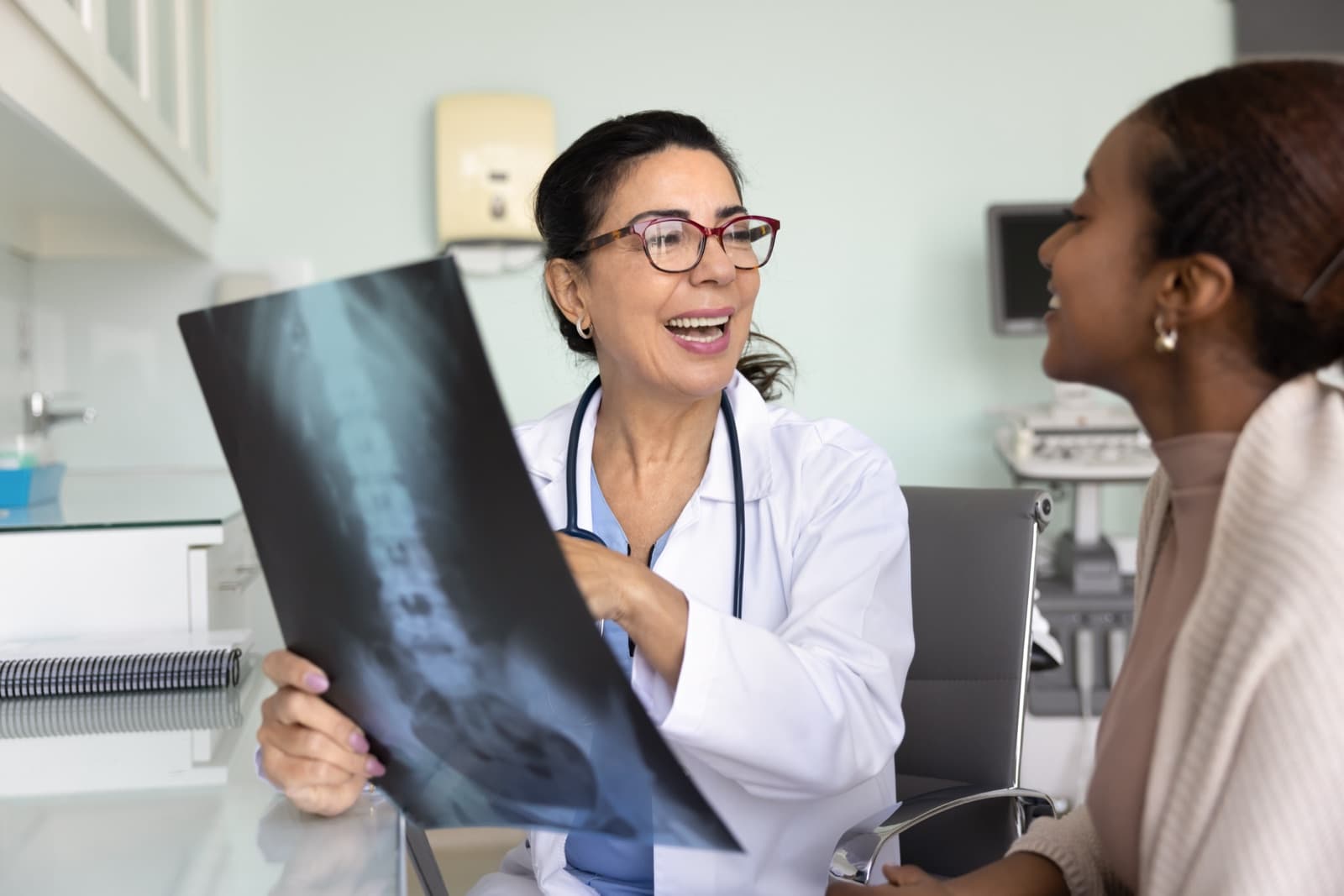
Explore conservative care
A hip replacement is a major operation with months of recovery. For many patients, physical therapy and autologous orthobiologic procedures are conservative, in-office options worth discussing — they differ from surgery in invasiveness, anesthesia, and recovery time.
Want the background? What are orthobiologic procedures?
Hip pain FAQs
Arthritis in more than one joint? See our arthritis & joint pain care.
Ready for a hip evaluation?
Book an evaluation at our Addison clinic — we'll assess the source of your hip pain and walk you through your options.